
You can follow our portfolio and take advantage of it. Our portfolio is not a buy recommendation.

Crypto CFD, what does this mean? – THIS IS WHAT YOU NEED TO KNOW!

Crypto CFD Trading Explained

Cryptocurrencies are the youngest asset class in which it is possible to trade with CFDs . Trading with CFDs on cryptocurrencies is also called Crypto CFD Trading .

Cryptocurrency is known by different names, including crypto currency, crypto coins and crypto money. The most famous coin is Bitcoin. This cryptocurrency has increased by a factor of 8 in just one year. If you had bought 1,000 euros in Bitcoin CFDs with 5x leverage a year ago, you would now have 40,000 euros in your portfolio. Bitcoin is far from the only cryptocurrency. Some other coins have achieved even better results. Want to know more about trading CFDs on Bitcoin? Then read our article: ‘ Bitcoin CFD ‘.

CFD stands for Contract For Difference and is a powerful, simple and flexible trading instrument that can be extremely suitable for effectively executing a crypto trading strategy. 

Cryptocurrencies are highly volatile , so caution is advised. When trading cryptos via a CFD, your capital is at risk. Before we go further into trading CFDs on crypto, it is important to know what cryptocurrencies are.

Crypto CFD Trading Explained

Cryptocurrencies are the youngest asset class in which it is possible to trade with CFDs . Trading with CFDs on cryptocurrencies is also called Crypto CFD Trading .

Cryptocurrency is known by different names, including crypto currency, crypto coins and crypto money. The most famous coin is Bitcoin. This cryptocurrency has increased by a factor of 8 in just one year. If you had bought 1,000 euros in Bitcoin CFDs with 5x leverage a year ago, you would now have 40,000 euros in your portfolio. Bitcoin is far from the only cryptocurrency. Some other coins have achieved even better results. Want to know more about trading CFDs on Bitcoin? Then read our article: ‘ Bitcoin CFD ‘.

CFD stands for Contract For Difference and is a powerful, simple and flexible trading instrument that can be extremely suitable for effectively executing a crypto trading strategy. 

Cryptocurrencies are highly volatile , so caution is advised. When trading cryptos via a CFD, your capital is at risk. Before we go further into trading CFDs on crypto, it is important to know what cryptocurrencies are.

What are cryptocurrencies?

Cryptocurrency can be seen as digital money. These virtual coins exist in a decentralized computer network and are not backed by any underlying value, except the trust that people have in this new form of money. Because there is no central bank or government that issues crypto money, there is no one who can manipulate this process from the outside. The only way to create the currency is within the computer network.

This is done by means of the blockchain, a virtual ledger in which all transactions that have ever been done with a cryptocurrency can be found. This ledger is updated every few minutes with the latest transactions. These new transactions together form a ‘block’, which is in turn linked to the previous block. Hence the name blockchain.

Every new block is created by miners. Miners are powerful computers that provide large amounts of computing power to keep the blockchain secure. The system is not easy to manipulate, because no one can predict in advance which miner will generate the next block. Mining Bitcoin is very lucrative, because miners receive a reward in the form of coins if they add a correct block to the chain.

With the help of the blockchain it is possible to check exactly how much crypto is in the account of each participant and where it comes from. This makes cryptocurrencies theoretically many times more transparent than normal bank accounts. However, it is not possible to determine which account numbers are owned by which persons. The only person who can spend the money in the account is the person who has the private key. This is a kind of password. This makes the blockchain anonymous in practice.

Trading in cryptocurrency

Due to their high volatility, cryptocurrencies such as Bitcoin and Ethereum are very attractive for active investors and CFD traders. It is not unusual for a crypto coin to rise or fall by more than 5% within a day. The price can easily fluctuate by more than 20% within a week. This makes the opportunities great for active investors and day traders.

Cryptocurrencies are traditionally traded on specific ‘ exchanges ‘. These exchanges do have some disadvantages compared to CFD trading. Often the exchanges are slow, it is difficult to deposit money and you cannot trade with  leverage  or short. In addition, many exchanges are not regulated. In the past there have been problems with hackers, causing users who had their crypto on large exchanges such as Bitfinex and Mt. Gox to lose their money. 

CFDs offer more convenience. Traders can go long or short and trade with or without leverage. It is possible to buy CFDs on Bitcoin, Ethereum and other cryptocurrencies. With exchanges you own the coin(s), with CFD this is not the case. With CFD trading you speculate purely on the price movement of an underlying product.

This is how crypto CFD cryptocurrency trading works

It is much easier to speculate on various cryptocurrencies using one CFD trading environment. You can immediately start trading commission-free, for example, a Bitcoin, Ethereum, Litecoin or Ripple CFD. This requires a small deposit into your account. It is wise to compare different brokers and start small.

Potential Benefits of Trading Cryptos with CFDs

By means of a CFD, the investor can trade certain desired positions in cryptocurrencies, without owning the underlying asset. This makes it easy to take various positions to use leverage.

There are several problems with the current cryptocurrency exchanges. For example, these platforms are primarily targeted by hackers. The exchanges are, as it were, a kind of crypto banks. When hackers succeed here, they are in. Hackers try to plunder the accounts of the exchange, because the crypto money that investors have sent to the exchange wallet of a exchange is not under their own control. The aforementioned private keys are therefore not under their own control, which means that investors are, as it were, at the mercy of the good practices of the exchange and must trust that this is an honest and good company. It is very unwise to leave crypto on the exchange when it is not being traded. Anyone who goes long is best advised to safely store the cryptocurrency on a hardware wallet.

Finally, many crypto exchanges are small and young companies with a young development history. It still happens too often that the exchange is offline due to unexpected busyness. This can result in losses or cause additional returns to be missed because positions are not closed or opened in time.
The Benefits of a CFD Trading Exchange

A specific CFD trading platform is designed to allow the investor to open and close positions as quickly and efficiently as possible with a certain leverage. Thanks to the long history of development, ease of use is central. The investor can profit as much as possible from the volatility of cryptocurrencies, without having to have crypto money himself. When using leverage, there must be a minimum cover on the trading account as collateral. This is known as the margin.

CFDs make it possible to open a virtual position. This is a contract between  the broker  and the investor. The difference between the opening and closing position is settled between both parties. When the investor has closed his closing position with a loss, the deposit is used in the settlement. An example will clarify this further.

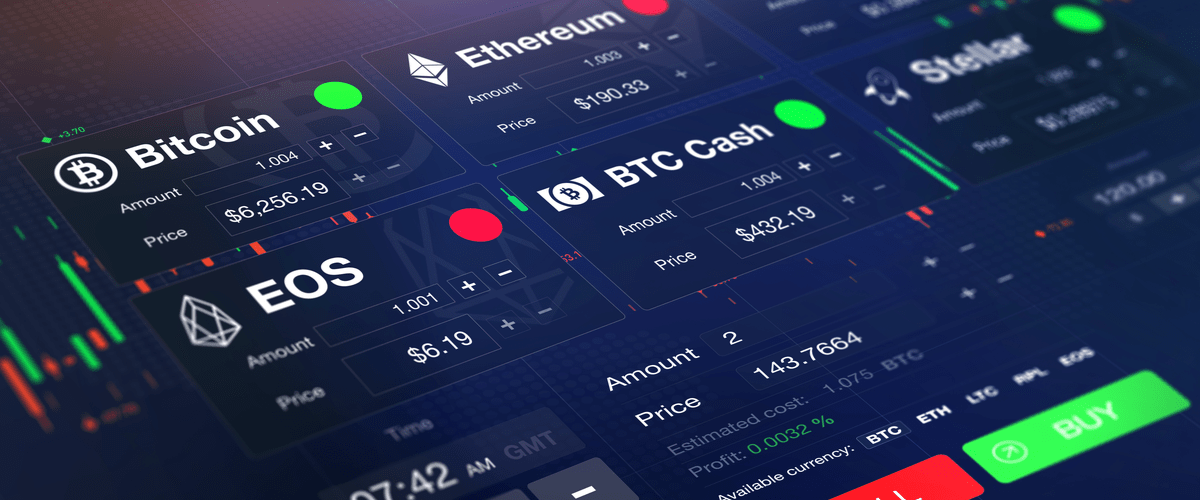
The investor chooses the direction to invest in (buy or sell). The buttons buy or sell respectively contain the points that must be passed for a successful trade. Suppose the number in a Bitcoin buy position is 4.5890, then the trade must be higher than this number at closing to be considered successful. You can trade in many different cryptocurrencies with CFDs, the best known of which is Bitcoin.

Bitcoin: de first mover 

Bitcoin is the first cryptocurrency. The blockchain is a relatively new invention that was first introduced in 2008 by Satoshi Nakamoto. Nakamoto is the pseudonym of the anonymous inventor(s). Shortly after the introduction of the blockchain, Bitcoin was born. Where in the beginning only a few miners were busy validating the blocks and there were hardly any transactions, the value of bitcoin was almost zero. Over the years, however, interest increased. More and more people made computer power available as miners and the first progressive companies started accepting bitcoins as a means of payment. The price of Bitcoin rose sharply amid fears about the stability of fiat currencies such as the dollar and the euro. In 2013, the price shot up from around $15 to over $1,200 per coin. However, the price collapsed again to around $200 in early 2015 after government intervention, a few hacks and the closure of Mt. Gox. This was the largest Bitcoin at the time.
 

Interest in Bitcoin remained limited for 18 months and the price remained fairly stable. Halfway through 2016, the crypto coin began a new advance. Possible causes of the renewed interest were online companies that started accepting BTC payments, the American elections and positive regulations in several countries including Japan.

Bitcoin made a huge rally with a peak of $20,000 in December 2017. This ATH (all time high) has now been broken. The new price record (at the time of writing) is $41,999. This can change quickly, because as mentioned before, Bitcoin is very volatile.

Andere cryptocurrencies

Bitcoin is not the only cryptocurrency that you can invest in with CFDs. There are a large number of alternative cryptocurrencies, or altcoins, to be found. Many of these added little, causing these altcoins to lose their value in a short time. However, the cryptocurrencies below actually offer something new or extra, causing these coins to see their own price explosion. Read more about  different crypto coins here .

Bitcoin is compared to gold and  Litecoin  to silver. This clone of Bitcoin has been around since 2013. Litecoin works with a different security algorithm. In addition, Litecoin generates blocks four times faster than Bitcoin, making transactions faster and cheaper. They may be less secure. The price of Litecoin has risen from around $4 to $150 in recent years.

Ethereum (ETH)  is also increasingly in the spotlight. This crypto project plays an important role in the world of Decentralized Finance. Ethereum is a decentralized computer, on which in theory every conceivable application can be run. Computing power on this computer is paid in the tradable ETH. In 2020, the price of ETH rose from around $150 to over $1660 in early 2021.

Monero  ‘s USP is that it is an open-source anonymous cryptocurrency. With Bitcoin, all transactions in the blockchain are completely transparent. However, money sent via Monero cannot be traced. This makes Monero popular with criminals and in 2016 this crypto was widely used on darknet marketplace Alphabay. The value of this cryptocurrency rose to $150 in January 2021 despite its shady use.

Ripple  can best be described as an online peer-to-peer payment network. This platform brings together supply and demand in all conceivable currencies. Ripple does this both between banks and individuals. In addition, Ripple has its own currency that works as a universal medium of exchange within the system. 

Crypto CFD Trading: The Best Crypto Brokers

Wondering where to trade cryptocurrency CFDs? Easily compare the best crypto CFD brokers. All these trading environments work great, but it is personal which broker suits your needs best.  So compare  them and take a look to find out which crypto broker suits you best.

Our reading tips

for the novice investor
Join thousands of others?

Become a member now and get instant access to our entire platform. 

The value we offer:

See also

Blogs

Day Trading Strategies for Beginners – TIPS & TRICKS

Strategies for Day Trading Day trading is the buying and selling of a financial instrument within the same trading day or even multiple times during the day. Profiting from small price fluctuations can be very lucrative if done correctly. However, it can be a dangerous game for beginners or investors who do not adhere to a well-thought-out strategy. Furthermore, not all brokers are suitable for the high volume of daily transactions by traders. Nevertheless, some brokers are specifically designed for day traders. Knowledge is power In addition to some knowledge of basic trading procedures, day traders should be aware of the latest news and events that affect the markets — What will interest rates do? What does the economic outlook look like? Etc.  Therefore, do your homework. Make a list of stocks you would like to trade and educate yourself about these companies and the markets in general. Keep yourself updated on business news and visit reliable financial websites. Set aside money Determine how much capital you are willing to risk per trade. Many successful day traders risk less than 1% to 2% of their account per trade. If you have a trading account of $40,000 and you are willing to risk 0.5% of your capital per trade, your maximum loss per trade is $200 (0.005 x 40,000). Use excess capital to trade that you can afford to lose in the event of a loss. Remember, it can happen. In addition to money, also set aside time Day trading requires your time. That’s why it’s called day trading. You’ll even lose a large part of your day. So don’t consider day trading if you have limited time. The process requires the trader to monitor the markets and spot opportunities that can arise at any time during the trading day. Acting quickly is essential. Start small As a beginner, focus on no more than 1 or 2 companies’ stocks during a session. Following and spotting opportunities and possibilities is easier with just a few stocks . It has become increasingly common to trade in “fractional shares”, which are, as the name suggests, smaller parts of a single share. This allows you to specify that you want to use a specific, smaller amount to invest. This means that, for example, Apple shares are trading at $250 and you only want to buy $50 worth of Apple shares, many brokers now allow you to buy one-fifth of a share. Avoid Penny Stocks  You’re probably looking for deals and low prices. However, stay away from penny stocks . These are often illiquid stocks with very little chance of making a big profit. Stocks that are listed for less than $5 per share are delisted from major exchanges and are only available over-the-counter. Unless you see a real opportunity and have done your research, stay away from these securities. Time your transactions Many orders placed by investors and traders are executed immediately when the markets open in the morning, which contributes to price volatility. An experienced player can recognize these patterns and profit from them. For novice day traders, it may be wiser to observe the markets without trading for the first 15 to 20 minutes. Volatility usually levels off halfway through the trading day, and then starts to increase again as the end of the day approaches. Although peak hours on the markets offer many opportunities, it is safer for beginners to avoid them. Limit losses with limit orders Choose what type of orders you place for your trades. Will you use market orders or limit orders? When you place a market order, it will be executed at the best available price at that time — so there is no price guarantee. A limit order, on the other hand, guarantees the price, but not the execution. Limit orders help you trade with more precision, where you determine a price (not unrealistic but feasible) at which the securities will be bought or sold. An advanced and experienced day trader can also use the addition of options to his/her strategy to hedge his/her own positions.   Be realistic about the profits A strategy does not always have to make a profit to be profitable. Most traders only make a profit on 50% to 60% percent of their trades. However, they make more on their profits than they lose on their losses. Make sure that the risk on each trade is limited to a specific percentage of your account and that your entry and exit strategy is clear and written down. Keep calm There are plenty of times when the markets will test your nerve. As a day trader, you will have to learn to control greed, hope and fear. Decisions should be made based on logic, not emotion. Stick to the plan Successful day traders need to act fast, but not think fast. Why? They have developed a trading strategy in advance, along with the discipline to stick to it. Instead of chasing profits, it is important to stick to your formula. Don’t let emotions get the better of you by giving up your strategy. Day traders have a common motto: “Plan your trade and trade your plan.” Getting started with day trading? Are you excited about day trading after reading this article? Then take a look at our range of CFD brokers , because these brokers work with leverage they are suitable for day trading. In this way you can have big consequences with a small investment. Please note, CFDs have an increased risk. 82% of retail investor accounts lose money when trading CFDs with this provider. You should consider whether you can afford to take the high risk of losing your money. Our reading tips for the novice investor

Lees verder >
Blogs

Popular Active Investment Strategies – THIS IS WHAT YOU NEED TO KNOW!

Popular investment strategies Active investing is the buying and selling of securities in the short term in order to profit from short-term price fluctuations in the stock market . The mentality associated with an active investment strategy differs from the long-term, buy-and-hold strategy that passive investors often employ. Active investors believe that by using short-term trends in the market, large profits can be made. There are several methods to implement an active investment strategy, each with its own appropriate market environment and risks that arise from the strategy. Here are the four most common active investment strategies and the costs of each strategy. *Plus500 is not suitable for inexperienced investors and ‘scalping’ is not allowed. Day trading Day trading is probably the most well-known active investment strategy. It is often seen as another name for active investing as a whole. Day trading, as the name suggests, is the method of buying and selling securities within the same day. Positions are closed on the same trading day they are opened, and are never held when the markets close. Day trading is normally only done by professional traders, such as specialists or market makers. However, with the advent of electronic trading, day trading is now also possible for novice investors. Position trading Position trading is considered by some to be a buy-and-hold strategy rather than active investing. However, when executed by an experienced investor, position trading can be a form of active investing. Position trading uses longer-term prices – this can be anything from daily to monthly data – in combination with other methods to determine the current trend of the market. Depending on the trends, these types of trades can last for days, weeks, or sometimes even longer. Trend traders look for successive “higher highs” or “lower highs” to determine the trend of a position. By riding the waves of these trends, trend traders attempt to profit from both rising and falling market prices. Trend traders therefore attempt to determine the direction of the market, but do not attempt to predict the price of instruments. Typically, trend traders jump in when the trend is identified and let go of their position when the trend disappears. This means that in periods of high market volatility, trading in trends becomes more difficult and the number of positions in them decreases. Swing Trading The moment a trend breaks is when swing traders jump in. At the end of a trend, there is usually some price volatility as the next trend emerges. Swing traders start buying and selling when that volatility occurs. Swing traders typically hold their positions for longer than a day, but for a shorter time than position traders. Often, swing traders create a set of trading rules based on technical analysis or fundamental research. These rules and algorithms are designed to determine when to buy and sell a security. While a swing trading algorithm does not have to predict the exact peaks and troughs of prices, it does require the market to move widely in one direction or another. Sideways markets or markets that remain at a certain level are risky for swing traders.  It is important to note that Plus500 does not offer hedging and swing trading. Scalping The investment strategy called scalping is one of the fastest strategies to be used by active investors. It involves investors profiting from various price differences caused by bid-ask spreads . This strategy works best by creating a spread by buying at the bid price and selling at the ask price, thus receiving the difference between the two prices. Scalpers hold their position for a very short time, which reduces the risk of scalping. In addition, scalpers do not try to profit from large swings or large trades. They try to take advantage of small fluctuations that occur frequently and thus make smaller trades more often. Because the profit per trade is small, scalpers look for liquid markets in order to increase the frequency of their trades. While swing traders look for markets where large, sudden fluctuations occur, scalpers look for quieter markets that are less sensitive to this in order to repeatedly profit from the same spreads. The Costs of Investment Strategies There is a reason why active investment strategies were first used by only professional traders. Besides the fact that a professional brokerage firm can reduce the cost of high frequency trades, it also ensures better execution of the trades. Lower commissions and better execution are two factors that improve the potential profits of the strategies. Typically, significant hardware and software purchases are required to successfully implement these strategies. Combined with the necessary real-time data, these costs may seem to make active investing very inaccessible to the individual investor, but it is not unattainable. This is why passive and indexed strategies that employ buy-and-hold methods can offer this at lower costs and also less tax in the case of potential profits.  However, passive strategies can never beat the market as they are often indexed to the general market. Active investors try to capture “alpha”, hoping that the profits they make from trading will be greater than the costs, in order to maintain a successful long-term strategy. If this is not successful, it is also possible to suffer greater losses. Getting started with an active investment strategy? Are you enthusiastic about active investing after reading this article and would you like to start? Then definitely check out our range of CFD brokers ! Because CFD brokers usually work with leverage, small price changes can cause large changes in the value of your portfolio. Pay close attention, CFDs usually involve greater risks. Therefore, read up on it and try out a demo account first if you have any doubts. Our reading tips for the novice investor

Lees verder >
Blogs

Forex Investment Strategies – TIPS & TRICKS

Forex Investing Strategies Forex (currency) is a subject that seems complicated to many people. In reality, forex is the same as other investments, if you don’t know much about it, it can be dangerous.  The good news for those looking for a forex strategy is that there are more than enough strategies for every investment horizon. Whether you are a long-term investor or someone who watches the market at all times looking for opportunities, as long as you are curious about forex strategies, you will find a strategy that suits you. Follow the daily or weekly trends A simple forex strategy is to follow the daily or weekly trends. Use the prices and charts to spot trends that seem well-founded and jump on them. A warning for this way of trading is that your trades may seem very small in relation to the prices, but in fact they could be hundreds of pips. This means you need to trade small. Be conservative in your allocation when you buy and allow your position to develop. Set a reasonable stop and plan a target. Beginners find this a simple strategy because you don’t have to constantly monitor the market, they can trade when they have time. Carry trade Carry trading is a method in which you buy and hold a currency that pays a high interest rate against a currency that has a low interest rate. You receive a daily rollover for the interest rate difference between the two currencies. The advantage of carry trading is that you receive income daily, even when your positions are not fluctuating. In addition, since most forex investments involve leverage, you get paid on the size of your trade, not the size of your capital.  The disadvantage of carry trading is that the interest rate differentials are often not that big compared to the risk you are taking. Furthermore, the currencies that are most suitable for carry trading are usually the currencies that react the most strongly to bad news about the global markets. In other words: as long as the economy is doing well, these currencies will continue to rise and pay out, but if things (unexpectedly) get worse, they will dive hard and fast. If your leverage ratio is too high, your account can quickly become a lot smaller. Day trading The Forex market is always moving. 24 hours a day, 7 days a week. Although the most active trading moments in Forex are quite specific times, the market always makes small movements. Depending on what you want to invest in, you can choose the best moment. Most day trading strategies are based on technical analysis, which has its advantages. Since the Forex market is very technical, you can profit from this with a sharp eye and a good plan. Fundamental trading Some investors take a more old-fashioned approach to their investments. They prefer to invest in something they understand rather than signals that charts and prices give. For this cautious investor, fundamental forex trading is best suited. Fundamental trading is following the news in different countries and investing in the countries with strong economic trends compared to the others. This approach is quite simple as it focuses on the long term. The tricky part is learning to understand the economic reports and comparing them to other countries. Our reading tips for the novice investor
Lees verder >
Blogs

Expensive VS Cheap Stocks – THIS IS WHAT YOU NEED TO KNOW!

Investing in expensive or cheap shares? Investors may have different ideas about what constitutes cheap and what constitutes expensive stocks . For some investors, an expensive or cheap stock refers to the price and what their investment will cost. For others, the term expensive or cheap refers to the relative value between a stock’s market price and its intrinsic value. Better indicators of whether a stock is expensive or cheap are the extent to which a stock reflects the company’s earnings and assets. Market Investors can’t always tell from the market price alone whether a stock is expensive or cheap. While some stocks command triple-digit sums, others trade for less than a tenner. Stocks with a high price are not necessarily expensive, and stocks with a low price are not necessarily cheap. Investors can bid a lot for a stock if they expect a lot of growth. The greater the growth potential of a stock, the more likely the high price is justified. On the other hand, if a stock with a low market price does not fully reflect the company’s poor growth potential, it can still be seen as expensive. Price-earnings ratio Investors also sometimes compare share prices to company earnings per share when valuing a stock. So whether a stock is expensive or cheap can depend on its price-earnings ratio. In general, the higher the price-earnings ratio, the more expensive the stock and vice versa. For stocks that have made high profits, the relatively high market price may still not be considered expensive if the price-earnings ratio is still low. For stocks that have made low profits and are therefore relatively cheap , they may not be considered cheap when the price-earnings ratio is high. Price-Equity Ratio Investors can also compare stock prices to a company’s equity to determine whether a stock is expensive or cheap, especially during periods of volatile earnings. A temporary increase or decrease in earnings can make a stock suddenly appear cheaper or more expensive than it may be in the long run. Comparing prices to equity often provides a more stable method of valuing a stock. The stock price to equity ratio is compared to the ratios of similar stocks or the industry average. The higher the ratio, the more expensive the stock may be, and vice versa. Shareholders The different numbers of outstanding shares between companies can make stocks appear more or less expensive than they actually are. Stocks with fewer outstanding shares are likely to trade at higher prices, but are not necessarily expensive when the ratios discussed earlier are low. Conversely, stocks with more outstanding shares often trade at lower prices, but are not necessarily cheap when the ratios are high. Without taking into account the number of shareholders, investors can misinterpret the share prices of companies with the same equity. Want to start investing in stocks? After reading this article, are you enthusiastic about investing in shares and are you convinced that this is something for you? Then definitely compare our  range of stock brokers  to find a provider that suits you best! Investing in cheap or ‘normal’ shares is currently being done by many people and is also one of the most popular forms of investment. Are you still in doubt? Try a demo account to learn how to invest in shares without risk! Our reading tips for the novice investor

Lees verder >
Blogs

Differences between stocks and bonds – THIS IS WHAT YOU NEED TO KNOW!

Stocks and bonds Investors are always told to diversify their portfolio between stocks and bonds, but what exactly is the difference between these two investments? Here we discuss the fundamental differences between stocks and bonds. Stocks are equity; bonds are debt Stocks and bonds are two different ways for an entity to raise money to operate its business. When a company issues stock, it is selling a portion of itself for cash. When it issues bonds, it is taking on debt with the agreement to pay interest for the use of the money.  Shares are simply small parts of a company. It works like this: a company has become successful after its start-up phase. The owners now want to expand, but are not able to do so by using only the income from their activities. For further financing, they can therefore go to the financial markets.  One way to do this is to split the company into pieces and sell some of these pieces on the market in a process called an IPO. A person who buys a share is actually buying a piece of the company, making him or her a partial owner (albeit a very small one). For the company, shares are therefore considered equity. Bonds, on the other hand, are debt capital. A government, company, or other entity that needs cash borrows money on the public market and then pays interest to these investors. Each bond has a certain nominal value (e.g. €1000) and pays a coupon (the interest payments) to the investors. With a 4% coupon, the investor receives €40 annually on the €1000 bond until the bond reaches its maturity. On the maturity date, the investor receives his full payment back, except in the rare case where the bond issuer can no longer meet the payment obligation. The difference for investors Given that stocks are partial ownership of a company — and therefore also of that company’s profits and losses — the value of an investment can grow when a company performs well. On the other hand, the value can also fall when the company does less well, or in the worst case, disappear completely in the event of bankruptcy. Bonds do not have the same high-return potential as stocks, but are preferred by investors who prioritize income. Bonds are also less risky than stocks. Although bond prices can fluctuate—sometimes quite dramatically due to higher-risk markets—most bonds repay their full amount at maturity and are much less likely to suffer losses than stocks. What is right for you? Many people invest in both stocks and bonds for diversification purposes. The right mix of stocks and bonds in your portfolio depends on your time horizon, risk tolerance, and investment goals. Our reading tips for the novice investor
Lees verder >