
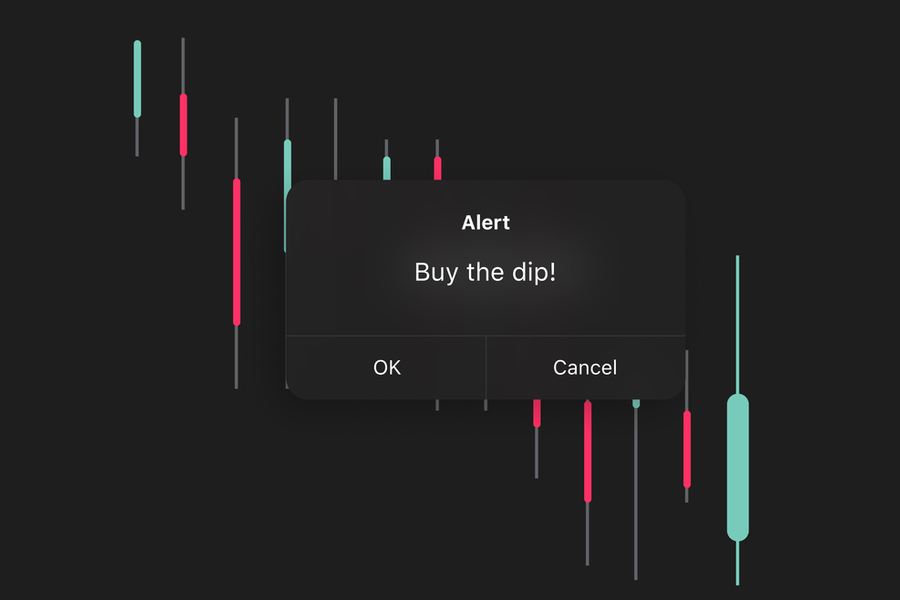

Wat is Buy the Dips?
“ Buying the dips ” means buying a security (usually stocks ) after it has fallen in price. The belief here is that the new lower price represents a bargain because the “dip” is only a short-term decline and the stock will likely bounce back and increase in value over time. Investors also often see this as “shopping” for stocks at a discount. Read more about this strategy in this blog!
Buying the dips: important to know
- Buying the dips refers to going long on a security after its price has experienced a short-term decline, on a repeated basis.
- Buying the dips can be profitable in long-term uptrends, but unprofitable or more difficult during long-term downtrends.
- Buying dips can lower the average cost of holding a position, but the risk and reward of buying dips must be continually evaluated.
Begrijp Buying the Dips
“Buy the dips” is a phrase that investors and traders often hear after a stock has fallen in price in the short term. After an asset has fallen from a higher price, some traders and investors see this as a good time to buy or add to an existing position. The concept of buying on the dip is based on the theory of price waves. When an investor buys a stock after a fall, he is buying at a lower price, hoping to make a profit when the market rebounds. You can then “shop” for stocks “cheaply” in this way. It is also sometimes referred to as discounted stocks.
Buying dips has different contexts and different chances of being profitable, depending on the situation. Some traders say they are “buying the dips” when a stock is falling within an otherwise long-term uptrend. They hope that the uptrend will resume after the fall.

Others use this expression when there is no long-term uptrend, but they believe that there could be an uptrend in the future. Therefore, they buy when the price is falling to profit from a possible future price increase.
If an investor is already long (already has the stock in the portfolio ) and buys on the dips, this is called “averaging down,” an investment strategy where additional shares are purchased after the price has fallen further, resulting in a lower average net price. However, if buying on the dips does not lead to a rebound later, it is said that adding to a loser.
Limitations of Buy the Dips
Like all trading strategies, buying the dips does not guarantee a profit. A stock can fall for many reasons, including changes in the underlying value . Just because the price is cheaper than before does not necessarily mean the stock is a good value.
The problem is that the average investor is not good at distinguishing between a temporary price decline and a warning sign that prices are about to fall much lower. While there may be unrecognized intrinsic value, buying additional shares simply to reduce the average cost of ownership may not be a good reason to increase the percentage of the investor’s portfolio exposed to the price action of that one stock. Proponents of this technique view averaging-down as a cost-effective approach to wealth accumulation; opponents see it as a recipe for disaster.
A stock that drops from $10 to $8 may or may not be a good buying opportunity. There may be good reasons why the stock is down, such as a change in earnings, bleak growth prospects, a change in management, poor economic conditions, loss of a contract, and so on. It could continue to drop, all the way to $0 if the situation is bad enough.
Risk Management When Buying the Dip
All trading strategies and investment methodologies must have some form of risk management. When buying a stock after it has fallen, many traders and investors will price it to manage their risk. For example, if a stock falls from $10 to $8, the trader may decide to cut his losses if the stock reaches $7. He believes the stock will go higher from $8, and therefore he buys, but he also wants to cut his losses if he is wrong and the stock continues to fall.
Buying dips usually works better for stocks that are in an uptrend. Dips, also called pullbacks, are a fixed part of an uptrend. As long as the price makes higher lows (in pullbacks or dips) and higher highs in the subsequent trend movement, the uptrend is intact.
Once the price makes lower dips, the price has entered a downtrend. The price will become increasingly cheaper as each dip is followed by lower prices. Most traders do not want to hold on to a losing stock and avoid buying dips during a downtrend. However, buying dips in downtrends can be suitable for some long-term investors who see value in the low prices, with the view that in the long term (years ahead) the price will recover.
An example of buying the dip
Consider the financial crisis of 2007-08. During that time, the stocks of many mortgage and financial companies collapsed. Bear Stearns and New Century Mortgage were among the hardest hit. An investor who routinely follows the philosophy of “buying the dips” would have picked up as many of these stocks as possible, assuming that prices would eventually return to pre-dip levels.
Of course, this never happened. Both companies closed their doors after a significant loss of stock value. New Century Mortgage’s stock fell so far that the New York Stock Exchange (NYSE) suspended trading. Investors who thought the stock was a bargain at $55 a share at $45 would face huge losses just a few weeks later when it fell below a dollar a share.
In contrast, shares of Apple (AAPL) have risen from around $3 to over $120 (split-adjusted) between 2009 and 2020. Buying the dips during that period would have rewarded the investor handsomely.
Our reading tips
for the novice investor